AI Guest Assistant for Holiday Rentals: Automate Guest Communication
Guest communication is one of the most repetitive parts of running a holiday-rental business.
Guests need answers before arrival, during their stay and sometimes late at night or at weekends. For a small operation, this can take up the owner's time. For a larger portfolio, it can create a significant workload for the guest-service team.
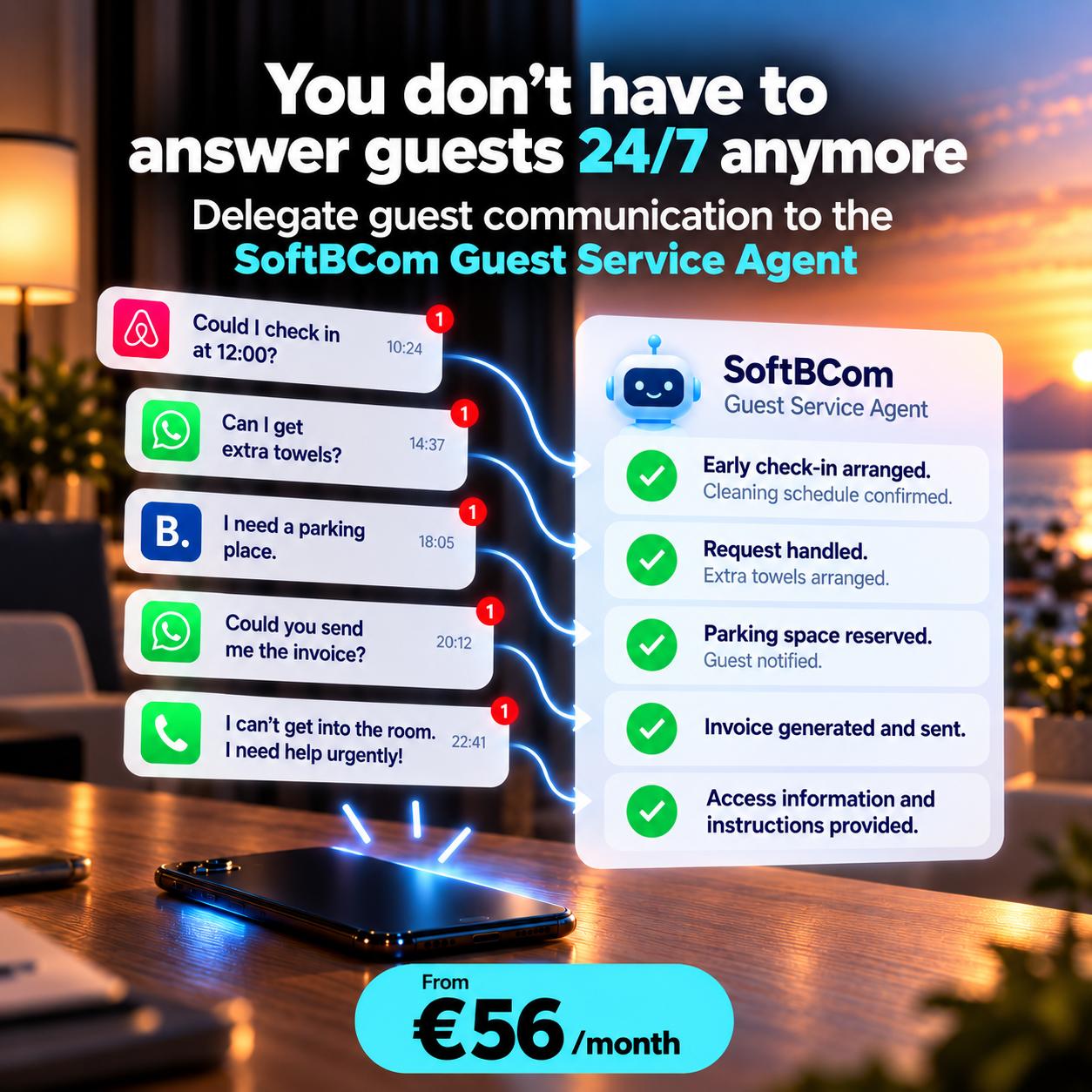
An AI Guest Service Agent can take over much of this routine communication by phone and in writing, while passing requests that require action to the right person.
The goal isn't simply to make AI talk to guests. It's to reduce the amount of manual guest-service work your business has to handle.
Can AI answer Airbnb and holiday-rental guest messages?
Yes — if the assistant is connected to the right guest communication and booking context.
When a guest writes in their booking conversation, the assistant can already know which apartment and stay the message relates to. There is no need to make the guest repeat basic information that is already available from the booking.
This makes a difference for everyday questions.
Guest:
“What’s the Wi-Fi password?”
AI guest assistant:
Provides the exact network name and password, including spelling it out on the phone or making it easy to copy in a chat.
Guest:
“Where can I park?”
AI guest assistant:
Provides the parking information stored for that particular apartment.
Guest:
“Can you send me directions?”
AI guest assistant:
Sends the relevant document or link.
These are exactly the kinds of interactions that can consume an owner's or guest-service team's time without requiring human involvement. The assistant can also handle access information, check-out questions, apartment facilities and invoices.
Can an AI guest assistant handle requests, not just questions?
This is where an AI guest assistant becomes more useful than a traditional chatbot.
A guest may say:
“I need an extra towel.”
Or:
“The heating isn't working.”
Or:
“I can't get into the apartment.”
These are not simply questions that need an answer.
Something needs to happen.
A Guest Service Agent can turn such requests into processes.
For example, a heating problem can be passed to the responsible caretaker with a notification and a reference. A request for extra towels can go directly to housekeeping. The owner or manager can decide who is responsible for each type of request and where the notification should go.
The result is a much simpler process:
Guest → AI Guest Service Agent → responsible person → completed request
instead of:
Guest → owner → find the right person → explain the problem → follow up → answer the guest
The difference is not just fewer messages.
It is less work for the owner, manager and guest-service team.
AI guest assistant vs. chatbot
A traditional chatbot mainly provides answers.
An AI Guest Service Agent can connect the guest conversation with the processes behind it.
| Traditional chatbot |
AI Guest Service Agent |
| Answers questions |
Answers questions and handles requests |
| Provides information |
Can initiate or complete processes |
| Passes problems back to staff |
Routes requests to the responsible person |
| Conversation is the end |
Conversation can lead to a completed task |
| Limited context |
Uses apartment and booking context |
For a holiday-rental business, this distinction matters.
The goal isn't to have a more sophisticated chatbot. It's to reduce the amount of work your team has to do manually.
Can an AI guest assistant handle phone calls?
Guest communication doesn't always happen through messaging. Some guests prefer to call, particularly when they need help immediately.
The assistant can work across voice and text. For phone calls, it matches the booking against arrival and departure dates before providing information belonging to the apartment.
This allows the same guest-service process to work across different communication channels.
Can an AI guest assistant communicate in different languages?
For international holiday rentals, language can quickly become another source of work.
The guest assistant can respond in the language the guest uses in voice and text, and switch languages when the guest does.
That means you don't have to personally translate routine questions or be available whenever an international guest needs help.
The guest gets the same service, regardless of when they arrive or which language they use.
What happens when a human needs to be involved?
Some requests require a person. The important thing is that they reach the right person rather than automatically landing on the owner or manager.
You can define who is responsible for different topics and where their notifications should go. Each request carries a short reference, and replying to the notification is enough to close it.
The process remains connected to the original guest conversation. You can see which requests were created, who received them and when they were completed, even when a process takes several days.
For an individual owner, this can mean fewer interruptions. For a property-management company or larger portfolio, it can mean less repetitive work for the guest-service team.
How do you prevent AI from giving guests wrong information?
This is one of the most important questions to ask before introducing AI into guest communication.
A useful assistant should work from reliable information and operate within clearly defined boundaries.
For example, the SoftBCom Guest Service Agent:
- releases access codes and Wi-Fi information only while the relevant stay is running;
- does not take over while the owner or team member is actively writing to the guest;
- does not issue a second invoice for the same stay;
- does not take sensitive address information over the phone;
- does not invent prices or promise times it does not know.
When information isn't available, the assistant says so rather than making something up.
Automation should not mean unlimited freedom. It should mean clearly defined responsibilities and boundaries.
How does the owner stay in control?
Owners can review conversation transcripts and written communications, trace the sequence of actions triggered by a customer request, and access detailed information on the costs associated with those actions. This provides full transparency into both the agent’s decisions and the resulting process execution.
SoftBCom Guest Service Agent operates under the full control of its owner.
What should you automate first?
You don't need to automate your entire operation at once.
Start with the guest communication that currently creates the most repetitive work. Once that is working, you can extend automation to other recurring processes such as service requests, housekeeping coordination or maintenance.
The system can keep related calls, chats and requests together, giving you visibility into what happened, who received a request and when it was completed.
This approach works whether you're managing a few apartments yourself, running a professional property-management business or operating a larger portfolio with a team.
SoftBCom Guest Service Agent starts from €56/month, with pricing depending on volume and processes.
Automate repetitive work. Keep people involved where their judgment is actually needed.
See what you could automate
Every holiday-rental business is different. The best place to start is with the guest communication and processes that currently create the most work.
Book a short call with SoftBCom to discuss your current setup and see what could be automated in your business.



.jpg)